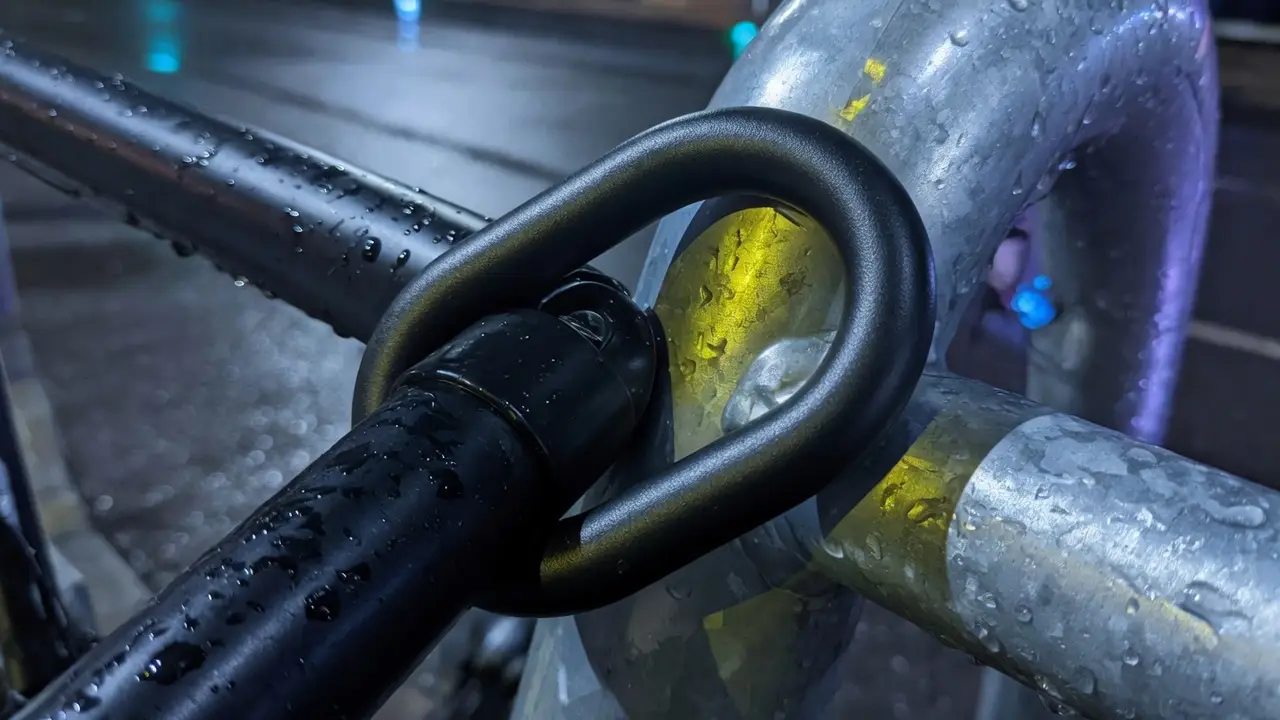
Grades come from Sold Secure. Weights and sizes come from the manufacturer specs.
What Gold and Diamond mean
Sold Secure tests bike locks and gives them a grade: Bronze, Silver, Gold, or Diamond. Gold is what a lot of UK home bike insurance still asks for. Diamond is the higher grade. Neither grade means a lock cannot be cut with an angle grinder.
There is a separate test for e-bikes. A lock can be Diamond for an ordinary bike and only Gold for an e-bike. That split matters if your e-bike policy names the e-bike grade.
Treat “20× more resistant” lines as marketing unless an independent grade is on the lock. Read best bike lock for insurance after this. We do not keep a live insurer list.
The cable is usually not graded
Plenty of Gold U-locks ship with a loop cable. On Kryptonite’s Mini-7 notes, that cable is not part of the Sold Secure approval. Use it for a quick-release wheel if you must. Do not treat it as a second Gold lock.
Will the lock close on your stand?
A compact lock that will not close around the stand does not protect the bike. Compare the locking area with the post plus the frame tube. Longer shackles (the ABUS 540 here is 300 mm) close more easily and also give a thief more room for a tool. Tight compact locks (the D1000 is 92 × 155 mm) are awkward on fat tyres and some cargo frames.
Will you actually carry it?
The lock you leave at home does not protect the bike at the station. On this site the Evolution Mini-7 is 1.61 kg with a clip; the Litelok X1 is 1.7 kg; the D1000 is 1.9 kg with no clip listed; the New York Mini is 2.06 kg with no clip; the New York 1410 chain is 4.9 kg. If you already skip 1.6 kg, do not buy 2 kg because the name sounds tougher.
D-lock or chain
A D-lock is for a tight stand on a commute. A chain is for extra length: home, a ground anchor, two bikes, or a post a compact lock cannot close around. D-lock vs chain is the longer comparison. Many riders use both and only carry the D-lock.
Which specs you can ignore
- Ignore anti-grinder marketing if you park in sight for ten minutes and Gold already meets the policy. Carry the compact lock.
- Ignore “Mini” if your stand is a fat lamp-post. Measure, then look at the 540 or a chain.
- Ignore e-bike Diamond if you ride an ordinary bike and the policy only names Gold.
- Ignore a 4.9 kg chain as a commute lock. That is a home lock.
Common mistakes
- Locking a wheel to the stand and leaving the frame open.
- Trusting a cable as if it were Gold.
- Buying Diamond, then leaving it at home because of the weight.
- Never checking the insurer’s approved-lock PDF.
Which lock to pick
A short match of job to the six locks we have reviewed.
| Situation | Pick | Why |
|---|---|---|
| Weekday commute, Gold is enough, you want a mount and a cable | Kryptonite Evolution Mini-7 | 1.61 kg, Gold, mount and cable in the box. The cable is not Gold. |
| Higher-value bike, public racks, you will carry about 1.7 kg | Litelok X1 | Diamond for bikes and e-bikes. Shackle 101 × 197 mm. |
| High-theft street, you have measured a compact shackle | Hiplok D1000 | Diamond, sold as anti-grinder. Compact 92 × 155 mm shackle. |
| Compact D-lock will not close; you still want Diamond for a non-e-bike | ABUS Granit XPlus 540 | 300 mm shackle. E-bike grade is Gold. |
| Home, garden, or a post a D-lock cannot reach | New York 1410 chain | 100 cm, 4.9 kg. Leave it at home. |
Full table: best of. Comparison: Evolution Mini-7 vs D1000.