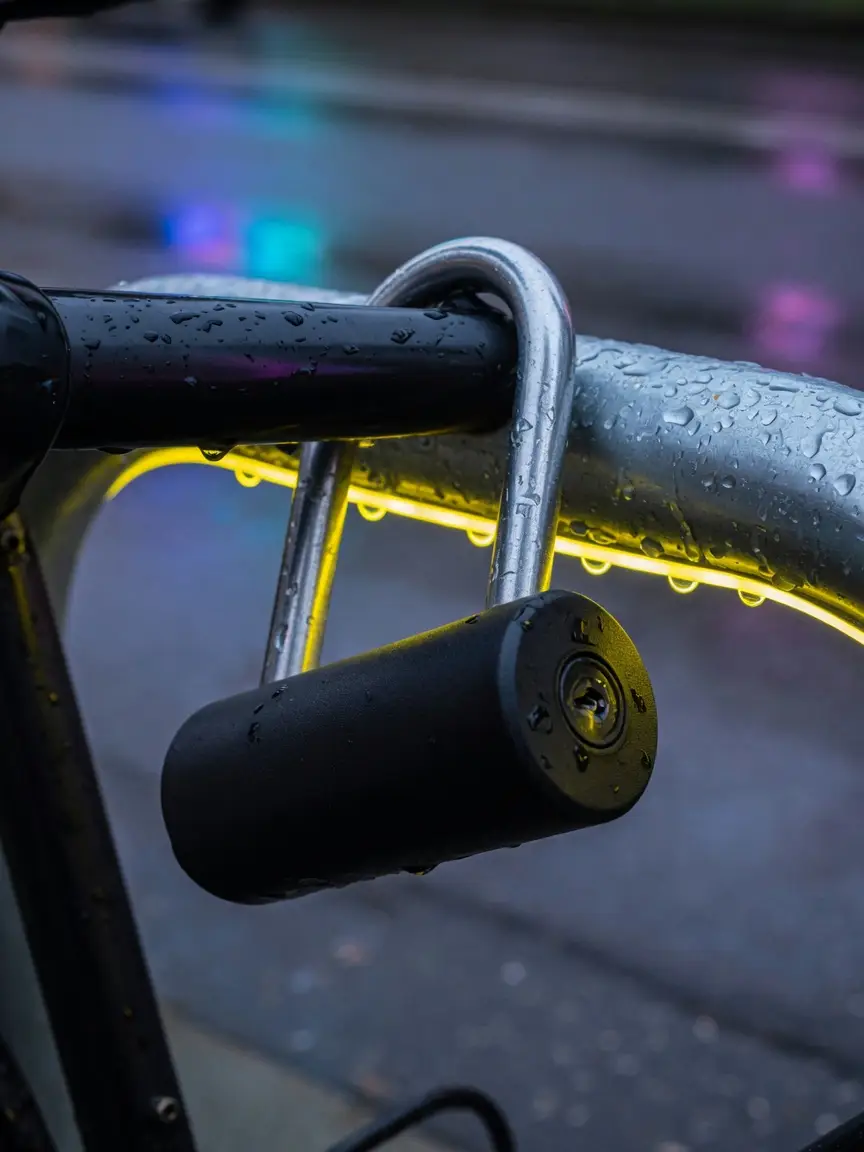
Checklist
- Confirm the policy names Diamond (ordinary bike or e-bike) before you shop on anti-grinder marketing alone.
- Measure the stand plus the frame tube — do not guess from a product photo.
- Decide how you will carry the lock; none of these three ships with a frame clip on the listings we checked.
- Treat maker cut-time claims as advertising; match the Sold Secure mark on the lock you receive.
Three Diamond locks sold with anti-grinder claims
Litelok · D-lock
Litelok X1
Sold Secure Diamond
When the policy names Diamond and you still need a weekday carry, start here — about 1.7kg.
1.7kg · 101×197 mm · 21 mm
Read the reviewNot currently available on Amazon UK
Hiplok · D-lock
Hiplok D1000
Sold Secure Diamond
For high-theft streets — but only after you have measured the stand and confirmed the small shackle will close.
1.9kg · 92×155 mm · 20 mm
Hiplok · D-lock
Hiplok DX1000
Sold Secure Diamond
A larger Hiplok than the D1000, still Diamond for bikes and e-bikes. At 2.75kg with no frame mount, it only makes sense after you have measured the stand.
2.75kg · 112×205 mm · 32 mm
Less suitable if: This page is for riders who already need Diamond and are comparing locks marketed against angle grinders. If your policy still names Gold and you will carry a compact Mini every day, start with the commuting guide instead.
“Anti-grinder” on a product page is the maker’s language. It is not a Sold Secure grade on its own. In the UK, the independent mark you match to insurance is still Sold Secure Gold or Diamond (and, on some policies, the e-bike grade). Treat cut-time claims and “20× more resistant” lines as advertising unless an independent grade is marked on the lock.
Start with the policy. If it still names Gold, an anti-grinder Diamond lock is the wrong upgrade for most weekday riders — a Gold Mini you take every day beats a heavier Diamond lock left at home. If the policy names Diamond, or the bike’s value and the street make Diamond the honest choice, then compare the three locks below on grade, locking area, and carry.
All three are Sold Secure Diamond for ordinary bikes and for e-bikes on the records we use. All three are sold with anti-grinder marketing. None of the listings we looked at include a frame clip, so budget for a bag or a separate mount. A Diamond lock that stays indoors does not protect the bike.
Measure the stand plus the frame tube before you order. The Hiplok D1000’s locking area is 92 × 155 mm. That is compact. Fat tyres, cargo frames, and some UK street furniture will not take it. The Hiplok DX1000 opens that to 112 × 205 mm at 2.75kg. The Litelok X1 sits between them on size at 101 × 197 mm and is the lightest of the three at 1.7kg.
For most people who need Diamond they will still carry, and who have not already measured a tiny shackle, the X1 is the clearer starting point. Choose the D1000 only after 92 × 155 mm closes on your stand and you specifically want Hiplok’s compact anti-grinder design. Choose the DX1000 when the D1000 will not close and you still want that Hiplok design on a larger hole.
Lock the frame to a fixed stand. Fill the shackle as much as you can. Check the stand is fixed down. Those habits matter as much as the marketing line on the box. For Gold daily carry, see the commuting guide. For matching a policy to a grade, see the insurance guide.
Still choosing on a weekday Gold policy? See best bike lock for commuting. Matching a Diamond line on the policy: best bike lock for insurance. Head-to-head Gold Mini versus the compact Hiplok: Evolution Mini-7 vs D1000. Choosing between the two Hiplok Diamonds: D1000 vs DX1000.
Full write-ups: Litelok X1, Hiplok D1000, Hiplok DX1000. How we treat grades and claims: how we research.
Common questions
Is “anti-grinder” the same as Sold Secure Diamond?
No. Anti-grinder is maker language. Diamond is the Sold Secure grade. A lock can be sold as anti-grinder and still need the Diamond mark to match a policy that names Diamond. Cut-times on a product page are advertising, not a grade.
Which anti-grinder lock should I buy first?
If you need Diamond you will still carry, and you have not measured a very small shackle, start with the Litelok X1: 1.7kg, 101 × 197 mm, Diamond for ordinary bikes and e-bikes. Choose the D1000 only after 92 × 155 mm closes. Choose the DX1000 when you want Hiplok’s larger 112 × 205 mm hole.
Will a Gold Mini stop an angle grinder?
Sold Secure Gold is not an anti-grinder claim. If your policy still names Gold and you will take the lock every day, a Gold Mini can still be the right commute lock. If the street or the policy is why you are shopping for anti-grinder marketing, you are in Diamond territory — and you still have to carry the lock.
Do any of these clip to the frame?
Not on the listings we looked at. The X1, D1000 and DX1000 are bag or separate-mount carries. If you need Diamond and a clip on the bike, look at the Pitbull STD instead — knowing it is not sold as anti-grinder.
D1000 or DX1000?
Same Diamond grade for ordinary bikes and e-bikes. The D1000 is 1.93kg with a 92 × 155 mm locking area. The DX1000 is 2.75kg with 112 × 205 mm. Measure the stand. If the smaller hole closes and you want the lighter Hiplok, take the D1000. If it will not close, take the DX1000 or look at the X1’s 101 × 197 mm area.
How to choose a bike lock · Best of · Reviews · Mini-7 vs D1000 · D1000 vs DX1000 · D-lock vs chain · Compact locks for flats · Delivery riders and e-bikes · Ground anchors · How we research