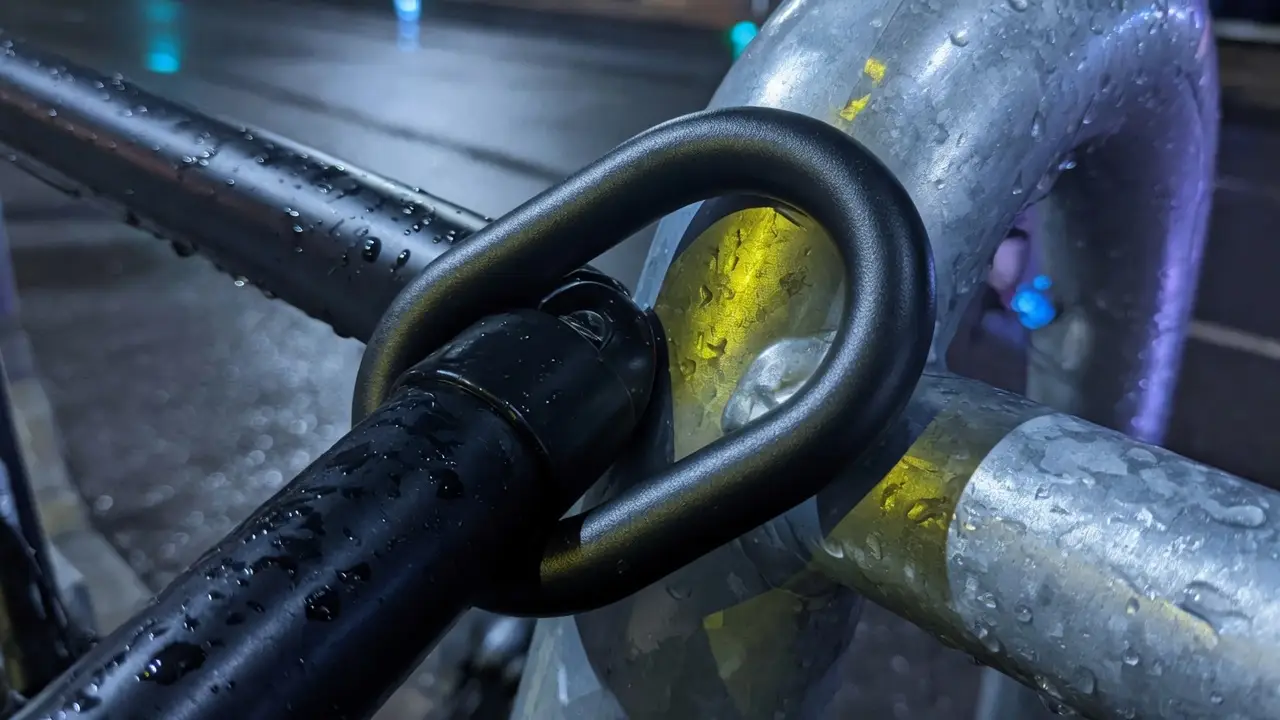
Short answer: a cable lock is enough for holding a wheel or saddle alongside a proper lock, or for a stop where the bike stays in sight. For anything longer, we'd use a graded D-lock or chain. If you're buying a cable to go with a D-lock, get one long enough to reach from the shackle through your front wheel, and with looped ends so the shackle can pass through.
When is a bike cable lock enough?
A cable is enough when it isn't doing the main job. The two places we'd use one are holding a quick-release wheel or saddle to a D-lock, and a very short stop where you can see the bike the whole time, like grabbing a coffee at a counter by the window.
Honestly, it isn't enough for a bike left at a station, a town-centre rack or overnight anywhere. Every cable can be cut with hand tools, and that's why none of the thirteen locks we've reviewed is a cable-only lock.
What length and thickness of cable lock is best for low-risk stops?
Length first, because it decides what you can loop. As a rough guide, a cable of about 120 cm reaches from a D-lock through your front wheel. That's the job the 4 ft cable in the Kryptonite Evolution Mini-7 box is made for. If you want to loop both wheels and the frame round a stand, you'll want something longer, and it'll be heavier and bulkier to carry.
Thickness helps, but less than you'd hope. A thicker cable takes more effort to cut, but it's still a cable. So we wouldn't pay extra for a very thick one and then use it as your only lock. If the stop is risky enough that thickness feels important, it's a D-lock stop.
What features should you look for in a cable lock?
Looped ends, if it's going with a D-lock. The shackle passes through both loops, so the cable holds the wheel and the D-lock holds everything.
A grade, if there is one. Most cable locks aren't graded by Sold Secure at all, and the ones that are tend to sit in the lower grades. Here's the thing: if a D-lock comes with a cable in the box, the grade on the box belongs to the D-lock and the cable isn't covered by it.
After that, it's comfort. A coated cable is kinder to your paint, a mount or a coil that clips on means you'll actually carry it, and a key lock or a combination is down to whether you'd rather lose a key or forget a number.
Cable vs chain vs D-lock: how does the security compare?
A cable is the easiest of the three to cut. A D-lock is a rigid steel shackle that's easy to carry and closes neatly round a Sheffield stand. A chain gives you the most reach, but the ones we cover weigh 4.9kg and 6.92kg. Bike lock types explained puts all four types side by side, and D-lock vs chain goes deeper on the two main locks.
For the grade, go by Sold Secure rather than the shape. Gold and Diamond are the grades UK insurers usually name, and you'll find those on D-locks, chains and folding locks rather than cables.
A D-lock that comes with a cable
If you want both in one box, two of the locks we've reviewed include a cable. The Evolution Mini-7 is Sold Secure Gold at 1.61kg, and the OnGuard Pitbull DT 8005 is Diamond at 1.6kg. Both have a frame mount.
Kryptonite · D-lock
Kryptonite Evolution Mini-7
Sold Secure Gold
The straightforward choice for a weekday commute when Gold is enough. It has a frame mount and cable and weighs 1.61kg.
1.61kg · 83×178 mm · 13 mm
OnGuard · D-lock
OnGuard Pitbull DT 8005
Diamond (ordinary bikes)
The same Diamond D-lock as the STD, with a cable and frame mount in the box. The cable itself is not Sold Secure graded.
1.6kg · 115×230 mm · 14 mm
Common questions
How do I choose the right bike cable lock for my needs?
Decide what it's for first. To hold a wheel alongside a D-lock, pick one with looped ends that's long enough to reach through the wheel, around 120 cm. For a short stop in sight of the bike, a coiled cable you'll actually carry is fine. For anything longer, use a graded D-lock or chain instead.
Are there places where a cable lock makes more sense than a chain or D-lock?
Only low-risk ones: a quick stop in sight of the bike, or holding a wheel and saddle while a D-lock does the main work. A cable is also useful for tethering a helmet or panniers.
Is the cable that comes with a D-lock Sold Secure rated?
Not usually. The grade belongs to the D-lock. The cables in the Evolution Mini-7 and Pitbull DT 8005 boxes aren't covered by their grades.
How to choose a bike lock · Best of · Reviews · D-lock vs chain · How we research